
Non-invasive vagus nerve stimulation modulates subthalamic beta activity in Parkinson's disease.
Non-invasive vagus nerve stimulation (VNS) may improve the movement problems experienced by people with Parkinson's. Here we recorded the brain activity of patients during VNS and found that the stimulation progressively reduced the abnormal activity (called beta) typically observed in the brains of people with Parkinson’s. These results show how VNS might be a non-invasive strategy to reduce parkinsonian motor symptoms.
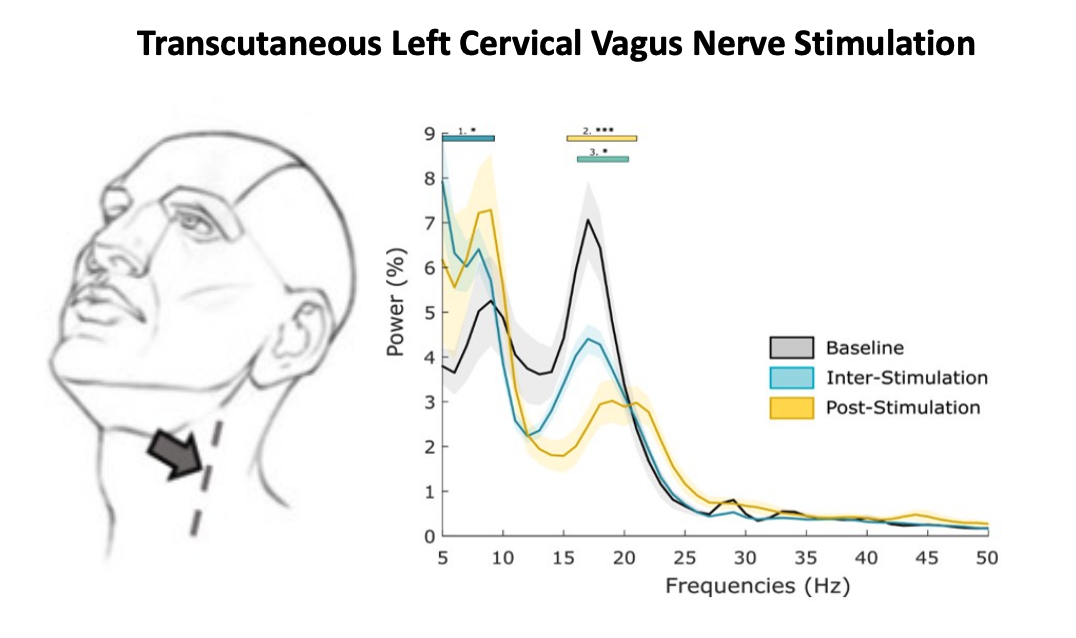
The left cervical branch of the vagus nerve was stimulated in seven patients with Parkinson’s. Simultaneous recordings of their brain activity (subthalamic nucleus, STN) revealed a progressive reduction of oscillatory power in the low beta band (blue) which reached its maximum after the 4th stimulation block (yellow).
Citation
2022. Brain Stimul, 15(6):1513-1516.
DOI
10.1016/j.brs.2022.11.006
Free Full Text at Europe PMC
Similar Content
Paper
2022. NPJ Parkinsons Dis, 8(1):88.
Paper
2021. J Neuroeng Rehabil, 18(1):179.
Paper
Suppression of pathological oscillations with transcranial focused ultrasound in Parkinson’s disease
Nat Commun, Epub ahead of Print (2026)
Paper
2026. Brain (e-Pub ahead of print).
Paper
2018. Neurobiol. Dis., 117(Sept):217-225.