Denison Group
The physiologic controls team explores novel technology to interact with the nervous system, with a goal to restore function in people with neurological and neurodegenerative disorders. Our translational engineering efforts include the creation of novel research tools for neuroscience discovery, and the application of the resulting discoveries towards developing better disease treatments.
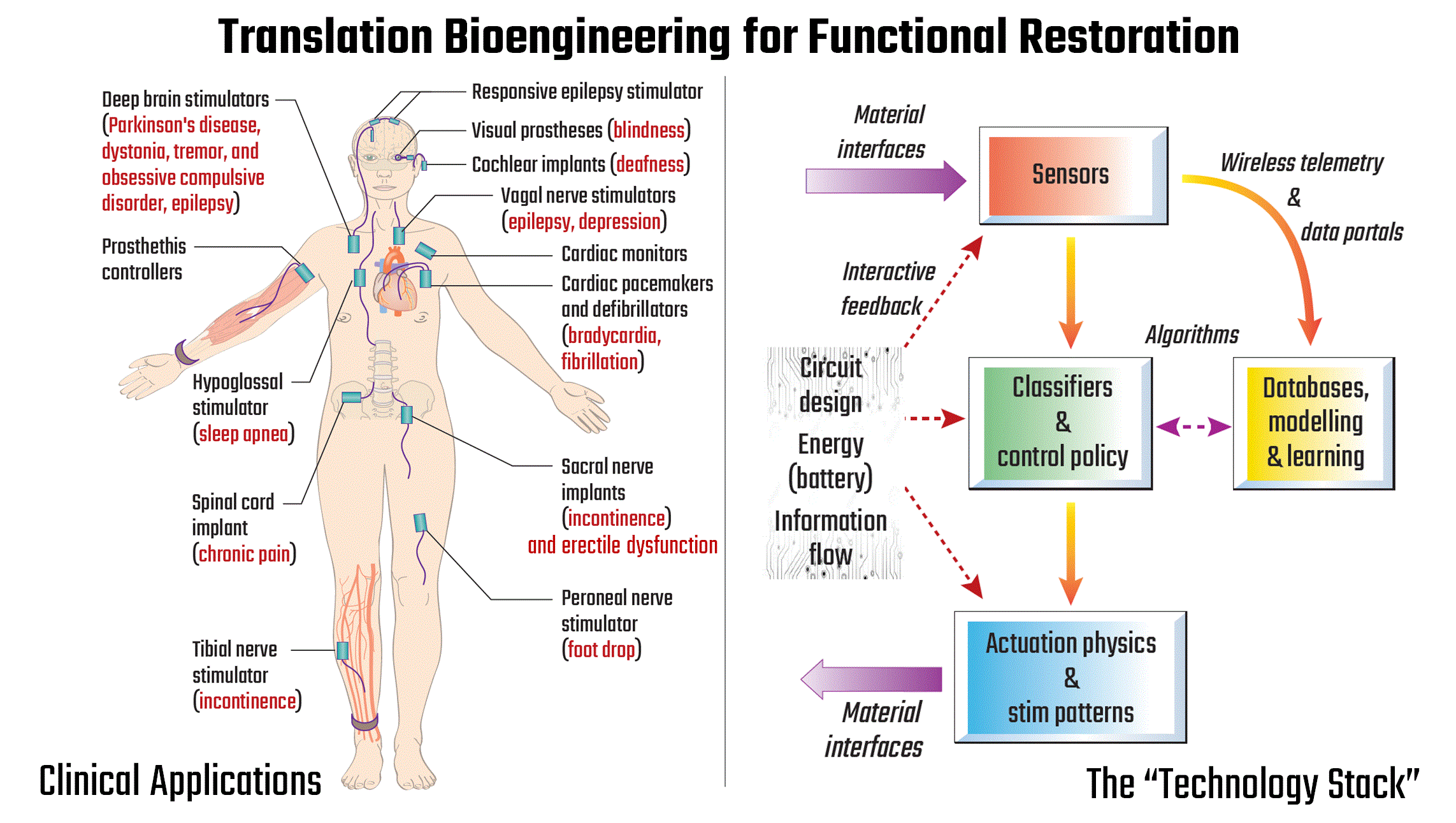
When treating neurological disorders, doctors have generally relied on drug discoveries. Yet the significant personal and societal costs incurred by such disorders, and current state of the pharma pipeline, motivate alternative approaches to treatment.
Bioelectronics work directly with the body's own nervous system to monitor brain signals and, as needed, modulate the electrical activity within nerves to alleviate symptoms of diseases. Examples of bioelectronic therapies for the nervous system include brain modulation for Parkinson’s and epilepsy, spinal cord stimulation for chronic pain, and sacral nerve stimulation for incontinence. Despite clinical success in treating symptoms of diseases like Parkinson's, existing bioelectronic systems have several limitations that arguably limit their adoption. For example, currently a skilled clinician is required to configure the implant, and the system's output is relatively inflexible to the rapidly changing and reactive activity of the nervous system.
The microelectronic basis and digital programmability of bioelectronic systems means that there is huge potential for flexibility in both research and future medical device design. Emerging technology offers the possibility of building restorative neural systems, which are adaptable and programmable for various diseases, as well as specifically for individuals. The codes used to programme the systems can be modified as scientific understanding of the brain evolves, and also be used to rapidly respond to physiological fluctuations within the body. But to fully realize this potential, we first need a better understanding of how the brain functions and responds to bioelectronic interventions.
To this end, our research explores new integrated bioelectronic hardware and software platforms for investigating foundational clinical neuroscience and improved treatments for neurological disorders. We partner with industry and clinical collaborators on both tool development and proof-of-concept testing (see highlighted publications). A common focus in on translating areas of neurotechnology that provide a high return on investment for the healthcare system (improvement in patient outcomes/cost for deployment). These prototypes often leverage established clinical pathways and commercial systems with a targeted technical upgrade enabling novel functionality. Examples include adding new stimulation pattern capability to an existing tonic stimulator to enable rehabilitation research, and adding sensing and algorithm circuitry to a deep brain stimulator to prototype bi-directional brain-machine-interfaces for treating brain disorders. The diversity of these applications reflects both the breadth of neurological disorders, and the potential of bioelectronic systems to address them.
DYNEUMO -- Implantable Bioelectronic Systems: Our team is co-developing with industry partners "instrumented medical devices" that enable clinical neuroscience discovery and prototyping of adaptive algorithms across timescales from milliseconds (e.g. respond to field-potentials) to hours and days (e.g. modulate circadian and ultradian rhythms). We are currently supporting pilot trials in multiple system atrophy, epilepsy, and chronic pain.
MAGNETO -- "Digital" Transcranial Magnetic Stimulation: Our team is co-developing with industry partners and colleagues in Engineering Science a new method for delivering non-invasive brain stimulation. Our technique will enable greater flexibility in patterns and pulse shapes compared to predicate designs.
MORPHEUS -- Sleep: Our international collaboration (Oxford, Surrey, Mayo Clinic, UCSF), funded by DARPA, is exploring the application of targeted brain stimulation for modulating sleep rhythms.
OPENMIND -- Platform Science: The OpenMind consortium (UCSF, Mayo Clinic, Brown University, and Oxford) is developing and managing neuroscience toolkits for instrumented medical devices.
- Bioelectronic systems design including micropower mixed-signal electronics, tissue-electrode interfaces, and algorithms
- Power electronics for megawatt pulse generation for transcranial brain stimulation
- Machine learning methods for assessment of large datasets enabled with our scientific instruments
- Mathematical models for assisting in algorithm design
- Quality management systems (e.g. 13485) and design controls for meeting regulatory requirements
We are committed to fostering an inclusive work environment that celebrates diversity and promotes equal opportunity within our group and the wider BNDU.
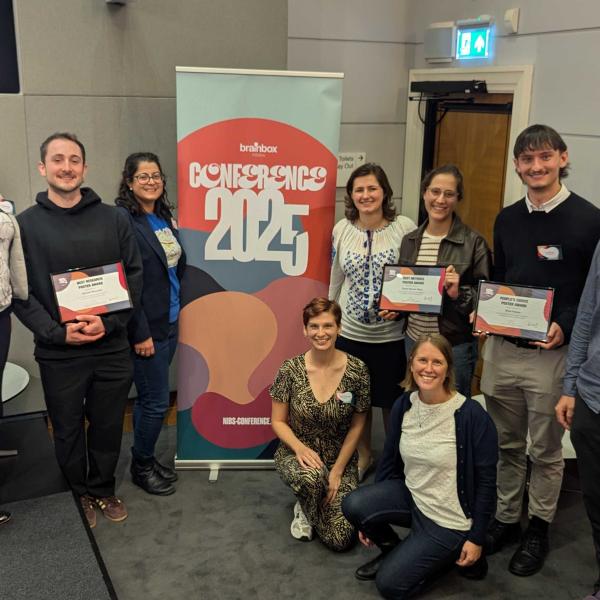

Mary Muers (far right) moderates an interactive session about training and career development opportunities.
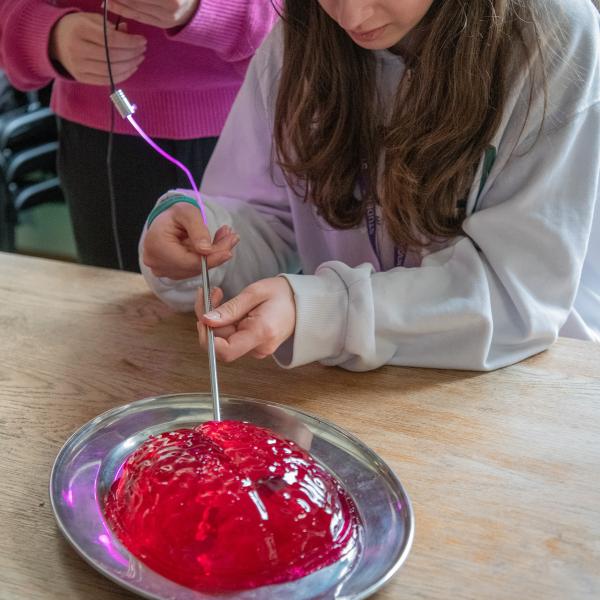
A visiting school pupil tries their hand at implanting a dummy stimulation electrode in a jelly brain!
Studentships
Project
Discovering and translating physiological biomarkers for personalised adaptive Deep Brain Stimulation in Parkinson’s disease
Deep Brain Stimulation (DBS) is an established therapy for Parkinson’s disease (PD), but its benefits vary across symptoms and between individuals. New generations of DBS devices can record brain activity as well as deliver stimulation, providing an opportunity to understand how neural dynamics relate to symptoms and treatment response. Identifying robust neural and behavioural biomarkers could enable stimulation to be adapted to an individual’s changing clinical state and improve treatment of both motor and non-motor symptoms.
The overall goal of this PhD studentship is to determine how neural and behavioural signals can be used to guide more personalised adaptive Deep Brain Stimulation for Parkinson’s disease. The project will combine brain recordings with measures of movement and behaviour across rest, movement, and sleep in people implanted with sensing-enabled DBS devices. Advanced analytical approaches will be used to identify biomarkers of clinically relevant states and to investigate how these biomarkers can inform new stimulation strategies. In doing so, the project aims to generate new mechanistic understanding of Parkinson’s disease while helping develop more responsive and personalised neurostimulation therapies.
The project will take place in the Brain Network Dynamics Unit of the Nuffield Department of Clinical Neurosciences and in the Medical Research Council Centre of Research Excellence in Restorative Neural Dynamics (MRC CoRE RND). Students will benefit from the extensive interdisciplinary skills training and personalised career development opportunities available within the Unit and the MRC CoRE RND. Students will receive specialised training in their areas of project research (see below) as well as, for example, in the translation and commercialisation of research, best practice in Open Science, and how to effectively involve and engage patients and the public with research.
Focusing on translational human neurotechnology, this studentship offers the opportunity to work with cutting-edge techniques including wireless neural activity streaming from implanted DBS devices, high density EEG, EMG, and wearable sensor recordings. You will develop advanced skills in signal processing, multimodal data integration, machine learning, patient-facing research, and the design and testing of adaptive stimulation paradigms. The project offers close collaboration with the functional neurosurgery service at Oxford University Hospitals, North Bristol NHS Trust, industrial partners Amber Therapeutics, and people affected by Parkinson’s. There will also be opportunities to collaborate through the Parkinson’s UK Deep Brain Stimulation Network and contribute to shared translational datasets.
This four-year Ph.D. (D.Phil.) studentship offers three years of full-time tuition fees at the Home rate, and four years of non-taxable stipend at the full-time UKRI rate (including any uplifts announced). Both Home students and International students are eligible to receive this funding package. Please see further details about MRC/UKRI studentships and UKRI guidance regarding Home and International eligibility. Successful offer-holders who have applied by the December deadline may also be considered for other University of Oxford scholarships.
Interested candidates should possess, or expect to receive, a 1st class or upper 2nd class degree (or equivalent) in a related scientific discipline, e.g. biological or physical sciences, medicine, computer science, engineering, mathematics. Applicants from experimental, clinical, engineering and computational backgrounds are encouraged.
Relevant experience in one or more of the following areas is desirable:
- Research experience in neuroscience, neurophysiology or a related field
- Signal processing or analysis of neural, physiological, movement or other biological data
- Programming for data analysis, for example in Python, MATLAB or R
Experience of human or patient-facing data collection, wearable or movement-sensor analysis, machine learning, or brain stimulation would be advantageous but is not essential.
Candidates must contact the lead project supervisor before submitting an application. To find out more about this studentship, the research project, and the application process, please contact Dr Ashwini Oswal by email on ashwini.oswal@ndcn.ox.ac.uk.
To be considered for this studentship, please submit an application for admission to the D.Phil. in Clinical Neurosciences at the Nuffield Department of Clinical Neurosciences (course code RD_CU1), following the guidance for applications to this course. On the application form, in the section headed ‘Departmental Studentship Applications’, please indicate that you are applying for a studentship and enter the reference code “27NDCN01MRC” into the funding tab.
The closing date for applications is 12.00 midday UK time on Tuesday 1st December 2026.
Supervisors
Applications are invited from both Home students and International students to join a multidisciplinary team of researchers studying how neural, movement and behavioural signals can be used to personalise adaptive deep brain stimulation (DBS) for Parkinson’s disease. This studentship is available from the start of academic year 2027/28, is for 4 years, and will be co-supervised by Dr. Ashwini Oswal, Professor Tim Denison, Dr. Hayriye Cagnan, and Dr. Bahman Abdi-Sargezeh at the MRC Centre of Research Excellence in Restorative Neural Dynamics.