
Dithering suppresses half-harmonic neural synchronisation to photic stimulation in humans.
Brain stimulation can guide brain rhythms, but perfectly regular pulses can also make off-target brain rhythms lock onto the stimulation. This study used flickering light and brainwave recording in healthy participants to test “dithering”, which consists in adding small timing jitters to the flashes. Dithering reduced unwanted brain synchronisation, suggesting a simple way to make future stimulation treatments more selective, and potentially safer, by avoiding off-target rhythms.
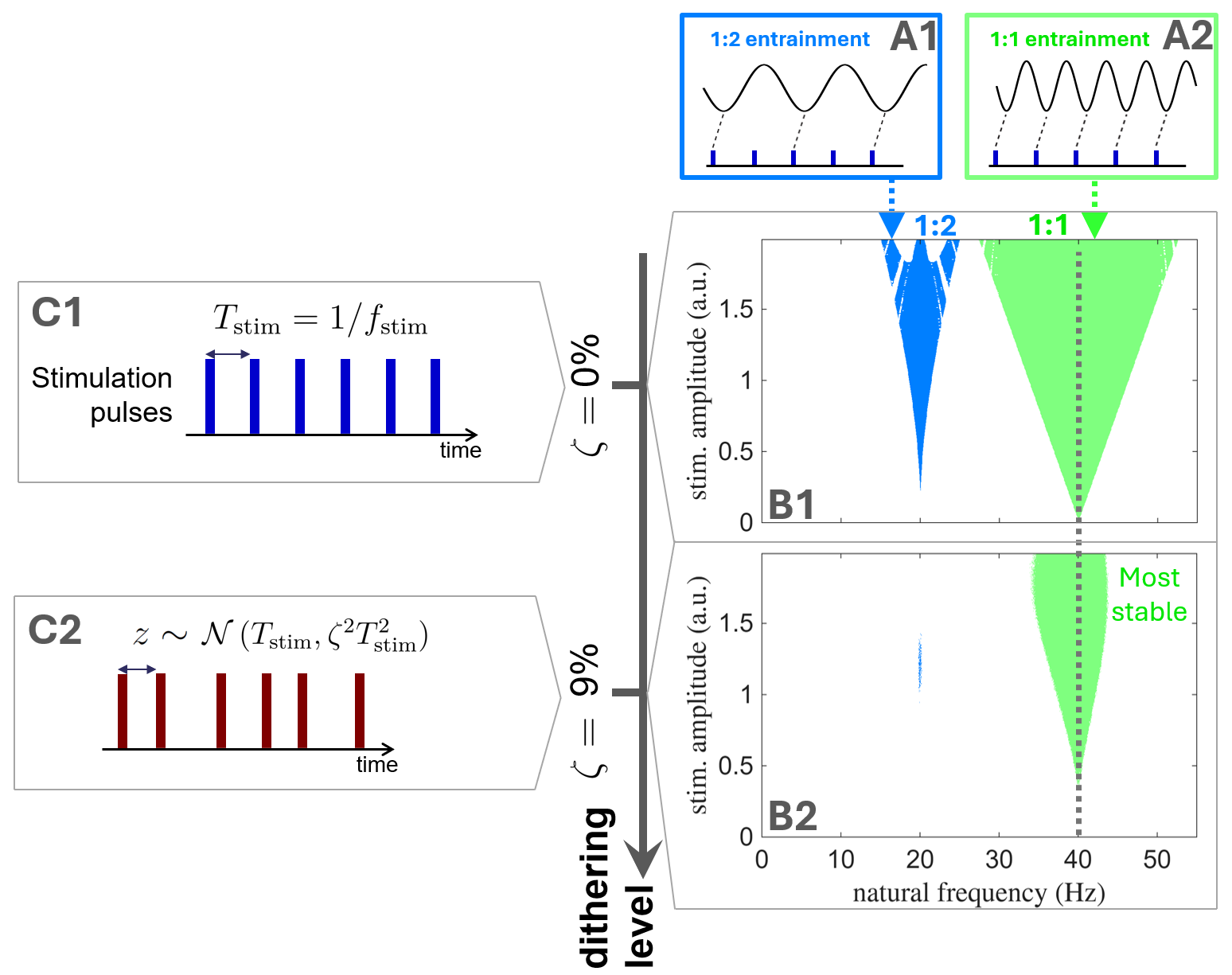
While entraining neural rhythms using brain stimulation has been suggested as a therapeutic mechanism to normalise brain activity in conditions such as depression, chronic pain, or Alzheimer's disease, periodic stimulation can also inadvertently entrain brain rhythms at sub- and superharmonics of the stimulation frequency, which could lead to deleterious effects. Slightly jittering stimulation pulses (called "dithering") was previously proposed on the basis of mathematical modelling to selectively entrain a target neural rhythm while avoiding harmonic entrainment. In this study, we investigated the potential of dithering in humans.
We recorded EEG in healthy adults during photic stimulation (light flicker) under periodic, dithered, reduced-strength, and control conditions. Synchronisation was quantified using spectral power and the phase-locking value.
We showed that dithering suppresses half-harmonic synchronisation relative to perfectly periodic flicker, and that dithering affects synchronisation at the stimulation frequency less than at the half-harmonic. This was also the case for a periodic condition with reduced stimulation strength, as predicted by theory. Furthermore, we demonstrated using synthetic data and modelling that the half-harmonic responses observed in participants cannot be explained by the superposition of evoked responses (even when modulated at the half-harmonic frequency), and are better matched by a minimal oscillator model.
Our findings are consistent with half-harmonic EEG synchronisation in response to photic stimulation predominantly reflecting half-harmonic entrainment rather than the summation of evoked responses, and with dithering being an effective strategy to suppress subharmonic entrainment without reducing the energy delivered.
2026. Brain Stimul, 19(3):103111.
2026. Brain (e-Pub ahead of print).