
Bidirectional Predictive Coding
Evidence suggests that the brain learns using two complementary processes: a fast process that quickly recognises sensory information, and a slower process that combines this information with prior expectations. Traditional predictive coding models focus on only one of these processes. Our research proposes a new predictive coding model that brings both together, allowing it to learn effectively across a much wider range of situations and more closely resemble how the brain adapts in different settings.
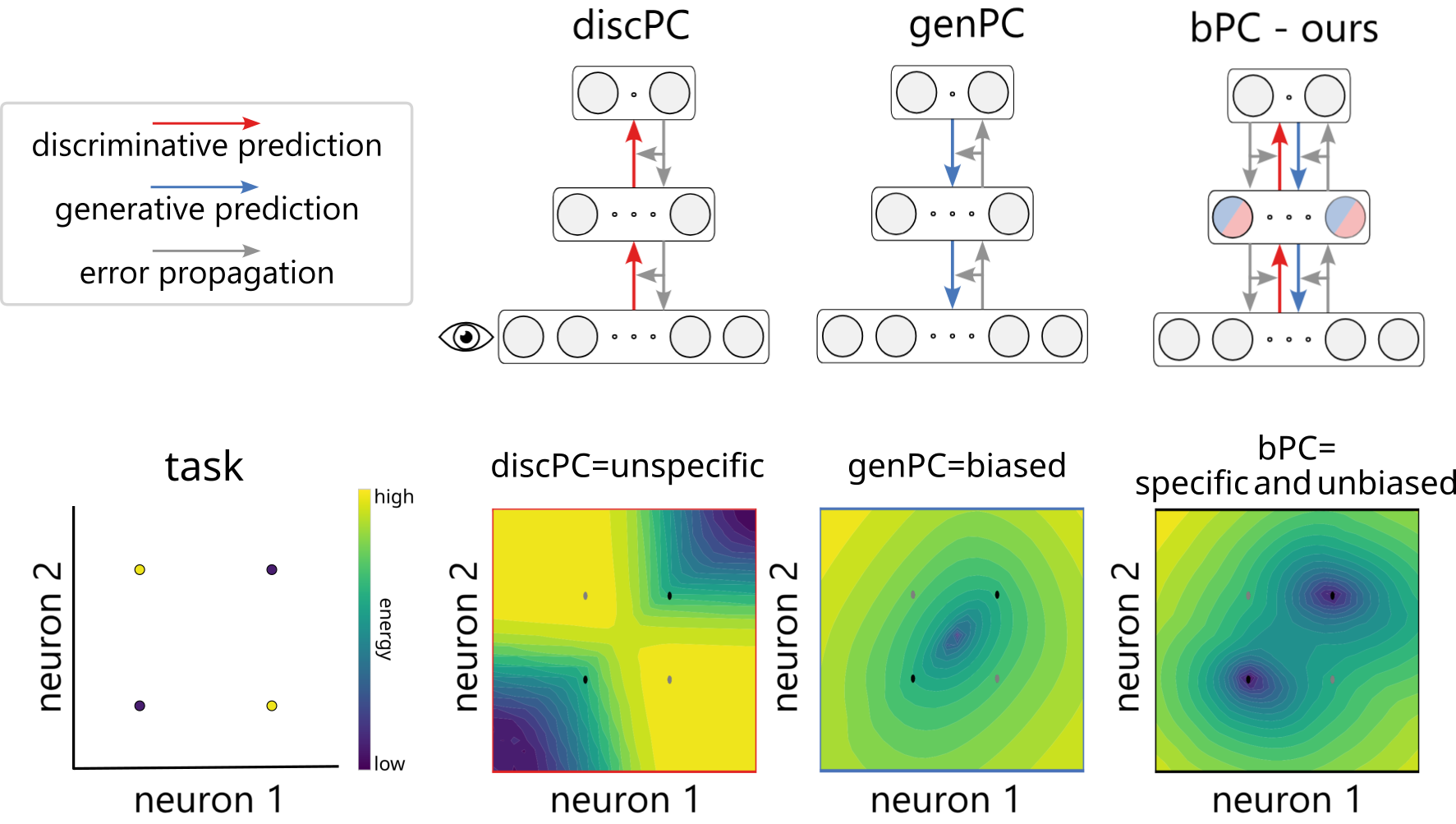
Predictive coding (PC) is an influential computational model of visual learning and inference in the brain. Classical PC was proposed as a top-down generative model, where the brain actively predicts upcoming visual inputs, and inference minimises the prediction errors. Recent studies have also shown that PC can be formulated as a discriminative model, where sensory inputs predict neural activities in a feedforward manner. However, experimental evidence suggests
that the brain employs both generative and discriminative inference, while unidirectional PC models show degraded performance in tasks requiring bidirectional processing. In this work, we propose bidirectional PC (bPC), a PC model that incorporates both generative and discriminative inference while maintaining a biologically plausible circuit implementation. We show that bPC matches or outper forms unidirectional models in their specialised generative or discriminative tasks, by developing an energy landscape that simultaneously suits both tasks. We also demonstrate bPC’s superior performance in two biologically relevant tasks including multimodal learning and inference with missing information, suggesting that bPC resembles biological visual inference more closely.
2024. PLoS Comput Biol, 20(10)e1012532.
2023. Adv Neural Inf Process Syst, 36:44341-44355.
2017.J Math Psychol, 76(Pt B):198-211.